

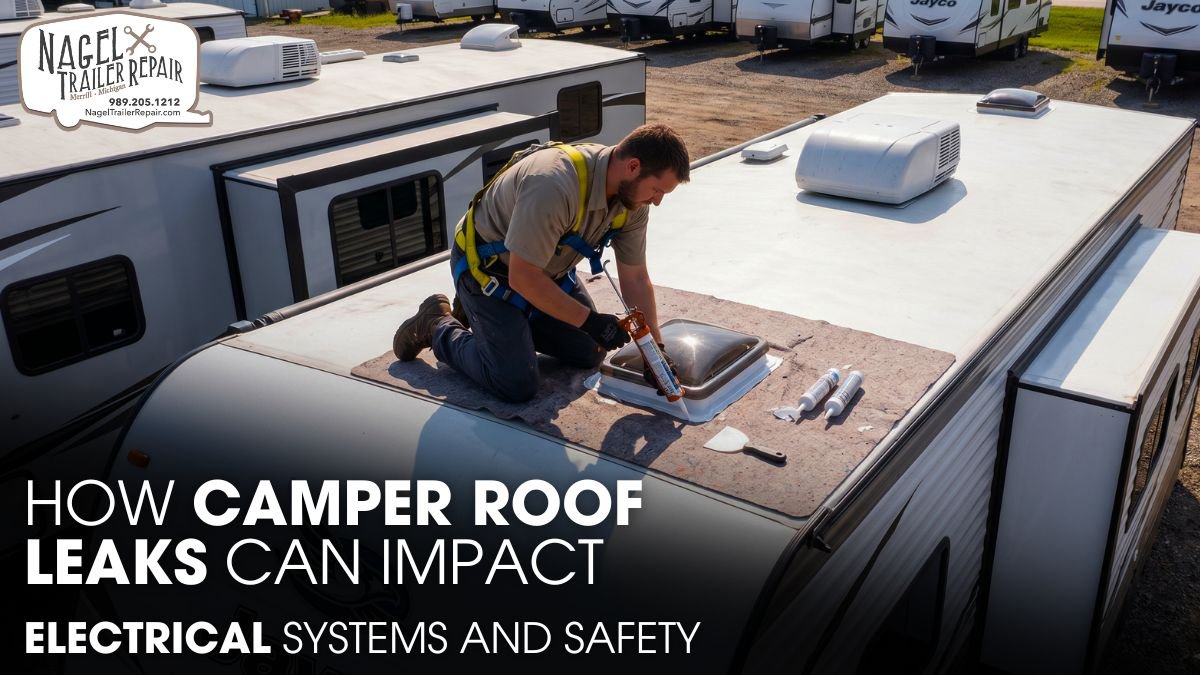
A small camper roof leak may not seem serious at first, but even a few drops of water can quietly damage critical electrical components. Moisture can slip behind walls, soak wiring, and weaken connections long before you notice visible signs inside your RV.
Many camper owners face unexpected issues like flickering lights, dead batteries, blown fuses, or even electrical fires caused by hidden water intrusion. Ignoring roof leaks can also increase repair costs and create serious safety risks for everyone traveling inside the camper.
This guide explains how travel trailer roof leaks affect electrical systems, warning signs to watch for, and why finding a trusted camper roofing shop in Michigan can prevent costly damage. Act early to boost safety, avoid electrical failures, and keep your camper road-ready.
Common Causes of Camper Roof Leaks:
Camper roofs deal with far more stress than most people realize. Unlike residential roofs, RV roofs constantly flex and vibrate while traveling. They also face direct sunlight, heavy rain, strong winds, snow buildup, and sudden temperature changes. Over time, these conditions slowly weaken the roof structure and create small openings where water can enter.
Most campers use roofing materials such as EPDM rubber, TPO membrane, fiberglass, or aluminum. Each material expands and contracts differently when temperatures rise or fall. This movement places continuous pressure on sealants around vents, skylights, antennas, air conditioning units, and solar panel mounts. Eventually, the sealant loses flexibility, dries out, or cracks.
Once the protective seal breaks, water begins moving underneath the roof membrane. Even a tiny opening can allow moisture to enter the roof cavity during heavy rain or while washing the camper.
Roof-mounted accessories create some of the most common leak points because installers must drill holes directly through the roof surface. Over time, road vibration loosens screws and weakens sealant around mounting brackets. Poorly installed aftermarket accessories often make the problem worse.
Several environmental conditions speed up roof damage:
- UV rays dry and shrink sealants
- Standing water weakens adhesives
- Tree branches puncture roof membranes
- Freeze-thaw cycles expand tiny cracks
- High humidity accelerates material breakdown
Many camper owners miss the early warning signs because water damage usually develops slowly. By the time stains appear on the ceiling, moisture may already have reached insulation, wood framing, and electrical wiring hidden behind the walls.
How Water Reaches Electrical Parts:
Water rarely stays in one location after entering a camper roof. Once it moves below the outer membrane, it follows gravity and spreads through structural cavities, insulation, and wiring channels. This movement makes electrical systems especially vulnerable.
Modern campers contain extensive electrical networks hidden behind ceilings and wall panels. Manufacturers route 12-volt DC wiring, 120-volt AC wiring, solar cables, and communication lines through tight enclosed spaces. When water enters these areas, it can travel long distances before becoming visible.
One major problem involves capillary action. Water naturally clings to surfaces, including wire insulation. Instead of dripping straight down, moisture can move along electrical cables and spread into fuse boxes, converters, inverters, and control panels.
The most vulnerable electrical components include:
- Converter chargers
- Shore power connections
- Battery disconnect systems
- Solar charge controllers
- Inverter units
- Grounding terminals
- Transfer switches
As moisture builds around these components, electrical resistance begins to change. Water contamination weakens insulation between conductors and creates unstable current flow. Over time, this condition leads to overheating and component failure.
Corrosion creates another serious issue. Copper wiring reacts quickly when exposed to moisture and oxygen. The metal forms oxide layers that reduce conductivity and increase electrical resistance inside the circuit.
Salt-heavy coastal environments make corrosion even worse because airborne salt accelerates oxidation. Campers stored near oceans or humid climates often experience faster electrical deterioration than units kept in dry regions.
Even a small amount of hidden moisture can damage sensitive electronic systems such as battery monitoring modules, smart control panels, and lithium battery management systems.
Electrical Problems Caused by Leaks:
Roof leaks can damage both low-voltage and high-voltage electrical systems inside a camper. The damage often starts gradually but becomes severe if moisture remains trapped inside the structure.
Corrosion remains the most common electrical problem caused by water intrusion. As copper terminals and wire connectors corrode, electrical resistance increases throughout the circuit. Higher resistance reduces current flow efficiency and creates voltage instability.
Electrical heat generation increases according to this principle: P=I²R
As resistance rises, heat builds rapidly at connection points. This overheating can melt insulation, deform connectors, and weaken nearby wiring.
Several common electrical problems appear after prolonged moisture exposure:
- Flickering interior lights
- Weak battery charging performance
- Random inverter shutdowns
- Repeated breaker trips
- Appliance malfunction
- Voltage fluctuations
- Dead outlets or switches
Short circuits become much more likely when water bridges energized conductors together. In AC systems, breakers may trip immediately. In DC systems, however, some short circuits can continue generating heat before fuse protection activates.
Water intrusion also affects camper batteries. Moisture around battery compartments increases terminal corrosion and may create parasitic current leakage between terminals. Lithium battery systems face even greater risk because their internal electronics operate within very narrow voltage tolerances.
Galvanic corrosion creates another technical concern. This process occurs when two dissimilar metals contact each other in the presence of moisture. Electrical current flowing between the metals accelerates material degradation.
For example, aluminum framing combined with copper wiring often produces aggressive corrosion around grounding points and connectors.
Modern campers also rely heavily on circuit boards and electronic control systems. Refrigerators, HVAC units, water heaters, and monitoring systems contain delicate microelectronics that cannot tolerate moisture contamination. Once water reaches these components, conductive residue can permanently damage the circuitry.
Safety Risks Linked to Roof Leaks:
Electrical damage caused by roof leaks creates serious safety hazards inside campers. Because RVs combine multiple electrical systems within a compact structure, even minor water intrusion can become dangerous. Most campers operate with both 12-volt DC systems and 120-volt AC shore power systems. When moisture reaches AC wiring, the risk of electric shock increases significantly.
Water lowers electrical resistance between energized conductors and grounded surfaces. As resistance decreases, current flow rises.
The relationship between voltage, resistance, and current follows this equation: V=IR
If water creates unintended conductive pathways, electrical current may flow through metal surfaces inside the camper. In severe cases, the camper chassis itself can become energized.
This situation becomes extremely dangerous when someone touches the camper while standing on wet ground. The human body can complete the electrical path to ground and receive a severe shock. Roof leaks also increase the risk of electrical fires. One major threat comes from arc faults. Unlike direct short circuits, arc faults produce intermittent electrical discharge that standard breakers may not detect immediately.
These high-temperature arcs can ignite surrounding materials such as:
- Wood framing
- Foam insulation
- Plastic wire jackets
- Ceiling panels
- Fabric wall coverings
Several common conditions trigger arc faults:
- Loose wire terminals
- Corroded connectors
- Wet extension cords
- Damaged transfer switches
- Overheated converters
Water intrusion may also damage circuit breakers and fuse panels themselves. Corroded protection devices sometimes fail to interrupt dangerous fault current properly, allowing overheating to continue longer than intended.
Beyond electrical hazards, long-term roof leaks create mold growth inside insulation and wall cavities. Excess moisture weakens wooden roof decking and structural supports over time. If left untreated, the roof may eventually lose structural integrity.
Warning Signs of Electrical Damage:
Early detection can prevent major electrical failure and reduce repair costs. Unfortunately, many warning signs appear slowly and remain unnoticed until the damage becomes severe. Flickering lights often provide the first clue. LED lighting systems react quickly to unstable voltage caused by corroded wiring or weakened ground connections.
Repeated breaker trips also signal potential moisture intrusion. Ground faults caused by water contamination often trigger intermittent shutdowns before complete circuit failure occurs.
Other important warning signs include:
- Burning plastic smells
- Warm wall surfaces
- Crackling sounds near outlets
- Inconsistent battery charging
- Sudden inverter shutdowns
- Rusted electrical terminals
- Moisture near ceiling fixtures
Thermal imaging inspections help technicians identify overheating electrical components hidden behind panels. Infrared cameras reveal high-resistance connections that generate abnormal heat due to corrosion. Moisture meters also help locate hidden water damage inside walls and ceilings before visible stains appear.
Battery compartments deserve close attention because moisture buildup accelerates oxidation around terminals and cable lugs. White, green, or blue deposits around battery connections usually indicate corrosion caused by moisture exposure.
Campers connected to shore power should also undergo regular cord inspections. Damaged or wet power cords create major electrocution and fire risks due to insulation breakdown.
Preventing Roof Leak Damage:
Preventive maintenance offers the best protection against roof leak-related electrical damage. Regular inspections and proper sealing techniques can prevent thousands of dollars in repairs.
Camper owners should inspect the roof every few months and after severe weather. Areas around vents, skylights, air conditioners, antennas, and solar mounts require special attention because these locations experience the highest leak rates.
Several maintenance practices improve long-term protection:
- Replace cracked sealant immediately
- Tighten loose mounting hardware
- Keep roof drainage areas clean
- Protect exposed wiring with conduit
- Use waterproof electrical connectors
- Apply dielectric grease on terminals
Professional leak testing systems provide even better protection. Many RV technicians now use pressurized air leak detection and ultrasonic testing equipment to locate microscopic leaks before visible water damage appears.
Electrical upgrades also improve overall camper safety. Ground Fault Circuit Interrupters and Arc Fault Circuit Interrupters detect abnormal current flow conditions early and reduce fire risk. Marine-grade electrical components provide stronger moisture resistance in humid environments. Heat-shrink connectors, corrosion-resistant terminals, waterproof junction boxes, and sealed cable glands significantly improve system durability.
Proper grounding remains critical for every camper electrical system. Corroded or loose grounding connections create unstable voltage conditions and increase shock hazards throughout the RV.
Solar panel installations require careful sealing because improperly sealed cable entry points have become one of the fastest-growing sources of camper roof leaks in recent years. Modern smart monitoring systems now include moisture sensors that alert owners when water enters electrical compartments. Early detection allows repairs before severe structural or electrical damage develops.
The Role of Professional Maintenance:
Professional maintenance helps camper owners avoid expensive repairs and unexpected safety issues during travel. Small roof leaks, damaged seals, or hidden moisture can quickly affect wiring, batteries, and electrical connections if technicians fail to detect them early. Regular inspections help identify weak areas before serious damage develops.
Experts also improve winter comfort by installing proper insulation materials around windows and vulnerable air gaps. Correctly fitted reflective insulation reduces heat loss, limits condensation buildup, and helps maintain stable indoor temperatures during cold-weather camping.
Routine servicing keeps electrical systems, roof structures, and insulation components working efficiently throughout the year. Professional inspections not only extend the camper’s lifespan but also improve safety, energy efficiency, and overall travel comfort in changing weather conditions.
Final Thoughts:
Camper roof leaks can silently compromise electrical systems long before visible damage appears. Moisture intrusion accelerates corrosion, weakens insulation, disrupts charging systems, and increases the risk of electrical fires and shock hazards.
Routine roof inspections, proper sealing techniques, and proactive electrical maintenance help prevent catastrophic failures. Trust experts like Nagel Trailer Repair to catch hidden issues early—safeguarding your camper from leaks and electrical damage while extending its lifespan.
Don’t wait for costly breakdowns. If you own a recreational vehicle, visit our trusted camper roofing shop in Michigan today. Addressing small leaks now improves safety, boosts travel reliability, and saves you from expensive emergency repairs down the road.